- Published: October 8, 2026
- //
- Blog
Why Your Migraine May Be More Than a Brain Problem
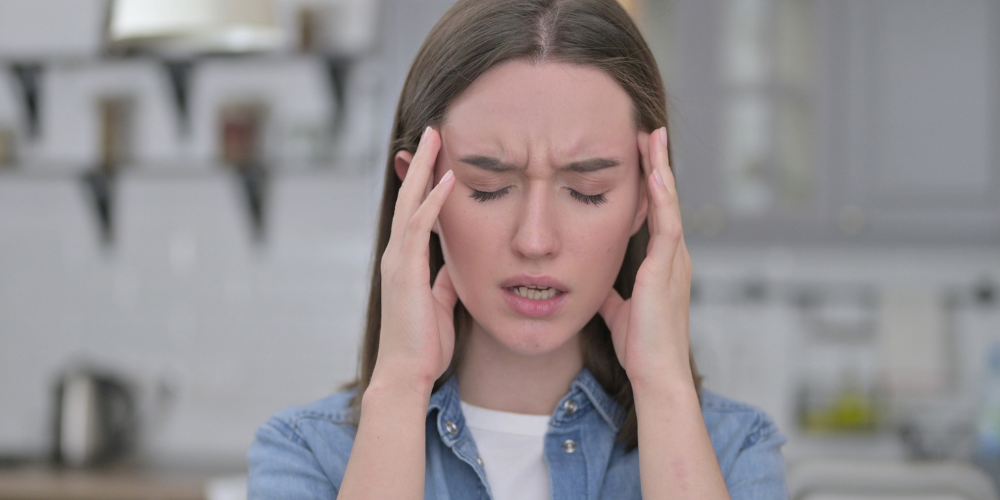
If you’ve been told your migraines are simply something you have to manage, you may be missing an important part of the conversation.
A migraine is felt in your head, but that does not mean every contributing factor starts there.
The neck, jaw, shoulders, sleep, stress, hormones, airway, nutrition, and overall health can all influence how your body experiences pain.
This was one of the most interesting points from my conversation with Dr. Jonathan Taves, a physical therapist who specializes in chronic headaches and migraines.
His approach looks beyond the location of the pain and asks a different question:
What could be contributing to the pain signal in the first place?
That question can change how you think about chronic headaches.
Your migraine may not be coming from your head alone
Pain is a signal.
The place where you feel pain is not always the place where the signal originates.
Think about referred pain. During a heart attack, for example, someone may experience pain in the shoulder even though the shoulder is not the source of the problem.
Headaches can involve a similar concept.
The upper neck, jaw, and shoulders can contribute to pain that is ultimately experienced in the head or face.
The upper cervical spine, particularly the first three cervical vertebrae, has important connections with the trigeminal system through an area called the trigeminocervical nucleus.
You don’t need to remember the name.
What matters is understanding that nerves carrying information from the head, face, and upper neck communicate with one another.
This means that a problem involving your neck or jaw can contribute to pain that you experience behind your eye, in your temple, or across your forehead.
That is one reason I don’t think headaches should always be approached as an isolated brain problem.
Your neck, jaw, and shoulders may be part of the picture
When someone has chronic headaches, it is worth looking at how the neck and surrounding structures are functioning.
Are you spending eight hours a day at a desk?
Do you have limited neck mobility?
Do you carry significant tension in your shoulders?
Do you clench or grind your teeth?
Do you have jaw pain or clicking?
Have you experienced whiplash or another injury?
These details can provide important information.
These issues through physical therapy, which focuses on movement and function rather than simply looking at static alignment.
The goal is to understand how the joints, muscles, and nervous system are working together and whether restricted movement or irritation could be contributing to the pain signal.
This does not mean every migraine is caused by a neck problem.
It means the neck and jaw should not automatically be excluded from the evaluation.
Hormones can influence your migraine threshold
This is especially important for women.
Some women notice that their migraines follow a very predictable pattern around their menstrual cycle.
They may occur in the days before their period, during their period, or around another consistent point in the cycle.
Hormonal fluctuations, particularly changes in estrogen, are recognized contributors to migraine for some women.
But I want to make an important distinction.
Hormones do not necessarily mean that estrogen is directly causing the pain you feel behind your eye or in your temple.
Instead, hormonal fluctuations can influence your nervous system’s sensitivity and your threshold for experiencing pain.
Imagine that you already have some degree of neck tension, poor sleep, jaw tension, or another physical contributor.
Then your hormonal environment changes.
Your ability to tolerate that existing input may change with it.
This can help explain why the same physical issue may be manageable at one point in your cycle but contribute to a debilitating migraine at another.
That is why I want to know about the timing.
When does your migraine happen?
Is it predictable?
Does it occur alongside PMS, heavy periods, mood changes, breast tenderness, or other hormone-related symptoms?
Those patterns are useful clinical information.
Your migraine may have more than one contributor
One of the concepts shared was three-spoke approach to headaches and migraines.
The first spoke is the source of the pain signal.
This may involve the neck, jaw, shoulders, or another physical structure.
The second is developmental or structural factors.
This can include previous injuries, prolonged postural patterns, connective tissue differences, or airway-related factors that affect how the head, neck, and jaw function.
The third is systemic health.
This includes factors such as hormones, sleep, stress, nutrition, inflammation, and overall health.
I like this framework because it reflects something I see clinically.
Your symptoms often have more than one contributing factor.
You may have neck tension and hormonal fluctuations.
You may have jaw tension and poor sleep.
You may have a physical problem that becomes much harder to tolerate when your stress level is high.
Instead of asking which one is the “real” cause, we can ask how these factors are interacting.
Don't overlook your airway
Many people never think to investigate their airway.
Breathing patterns during sleep can affect sleep quality, jaw positioning, and muscle tension.
Some people develop chronic mouth breathing or changes in jaw position that place additional stress on the surrounding structures.
Clenching and grinding can also contribute to jaw and neck tension.
A night guard may protect your teeth, but it does not necessarily explain why you are clenching or grinding in the first place.
If an underlying breathing or airway issue is contributing to that pattern, simply protecting the teeth may not address everything that is happening.
Airway concerns can be complex, so they should be evaluated by an appropriate healthcare professional when indicated.
Sleep matters more than you may realize
If your headaches are worse in the morning, I would pay attention to your sleep.
Do you wake with headaches?
Do you snore?
Do you breathe through your mouth?
Do you wake frequently?
Do you clench your jaw?
Do you feel rested when you get up?
Sleep affects nervous system regulation and pain sensitivity. When your sleep is consistently poor, your overall ability to tolerate pain and other stressors can change.
That does not mean poor sleep is automatically the cause of your migraines.
It means sleep is another part of the picture worth investigating.
Stress and inflammation can affect your threshold
Your body is constantly adapting to the demands placed on it.
But when several stressors accumulate, your ability to tolerate additional input can change.
Poor sleep, chronic stress, inadequate nutrition, hormonal fluctuations, and inflammation can all influence how your body responds to pain.
This is why two people with similar neck tension can have completely different experiences.
Their overall thresholds may be different.
Rather than simply telling someone with migraines to “reduce stress,” I prefer to look at the factors we can actually investigate.
How are you sleeping?
Are you eating consistently?
Are you getting adequate nutrition?
Are you moving your body?
Are your hormones fluctuating significantly?
Are there other symptoms suggesting that your overall health needs attention?
Those questions can give us a much more useful starting point.
Movement may be one of the simplest places to start
The health recommendation is surprisingly simple:
Walk.
For someone experiencing frequent migraines, intense exercise may not always be realistic.
Walking can be a much more accessible place to begin.
Regular movement can support mobility, sleep, stress regulation, digestion, and overall physical health.
If you spend most of your day sitting, even short periods of movement can help break up those static positions.
Take a walk.
Get up from your desk.
Walk after a meal.
Move around your house.
You don’t need a complicated program to start giving your body more movement.
Look at the pattern, not just the pain
If you have chronic headaches or migraines, start paying attention to the pattern.
Ask yourself:
- When do my migraines occur?
- Are they connected to my menstrual cycle?
- Are they worse when I am stressed?
- Do they follow poor sleep?
- Do I wake with headaches?
- Do I clench or grind my teeth?
- Do I have jaw or neck tension?
- Have I had a previous neck injury?
- Am I spending long periods in one position?
- Are there other hormone symptoms happening at the same time?
These questions don’t diagnose the cause of your migraine.
They help identify what may deserve further evaluation.
And remember, new, sudden, severe, or unusual headaches should always be appropriately evaluated by a medical professional.
Your migraine is information
A migraine is not simply something happening in your head.
The pain is real, but the systems contributing to that pain can extend beyond the location where you feel it.
Your neck and jaw may be contributing.
Your sleep may be affecting your pain threshold.
Your airway may need evaluation.
Your hormones may be influencing your susceptibility.
Stress, nutrition, and inflammation may also be part of the picture.
Sometimes, several of these factors are present at the same time.
That is why I believe good care starts with asking better questions.
Instead of only asking, “How do we stop this migraine?”
We can also ask:
“Why is your body becoming more vulnerable to this pain?”
That shift allows us to look at the whole person instead of treating one symptom in isolation.
If your migraines follow your menstrual cycle or occur alongside other hormone symptoms, it may be worth looking at the hormonal and whole-body factors that could be contributing.
If you want to hear more from Dr. Erin Ellis about how hormones may fit into the larger picture of migraines and chronic headaches, listen to the full episode of the Hope Natural Health Podcast with Dr. Jonathan Taves.
Tags :
- brain
- /
- brain function
- /
- chronic
- /
- health
- /
- hormone health
- /
- hormones
- /
- sleep
- /
- stress
- /
- women's health
Share :
-
Fb
-
Pn
-
Ln
Keep Up With Articles