- Published: November 26, 2026
- //
- Blog
Perimenopause Testing: Can a Blood Test Tell You If You’re in Perimenopause?
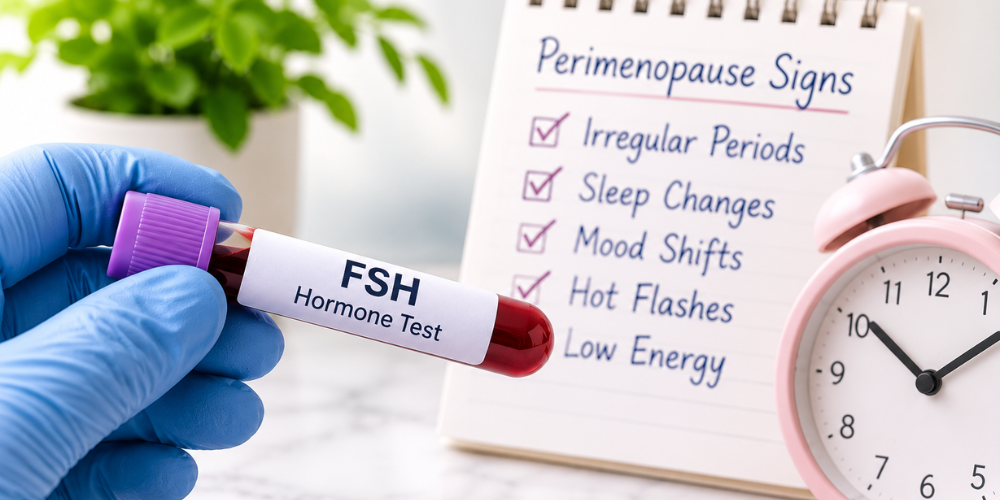
Women in their 40s often notice changes in their periods, sleep, mood, and energy before they know whether they’re entering perimenopause. A blood test may come back normal, leaving them unsure whether their symptoms are related to hormonal changes.
Perimenopause testing isn’t as straightforward as checking one hormone level. Menopause is confirmed after 12 consecutive months without a period, while perimenopause is evaluated through menstrual cycle patterns, symptoms, and timing. A single follicle-stimulating hormone (FSH) result can be misleading because hormone levels fluctuate throughout the transition.
Understanding what testing can and cannot tell you helps you have a more productive conversation with your healthcare provider.
Is There a Test for Perimenopause?
There isn’t one blood test that can reliably tell you exactly where you are in the menopause transition.
To understand why, you first need to know the difference between menopause and perimenopause.
Menopause is defined as 12 consecutive months without a menstrual period, provided there is no other explanation for the absence of bleeding. Those other explanations may include pregnancy, certain medications, hormonal contraception, or a medical condition.
You cannot confirm menopause after one, six, or even eleven months without a period. The 12-month milestone must pass before menopause can be identified.
In the United States, the average age of menopause is around 52, although the timing varies from woman to woman.
Perimenopause is the transition leading up to menopause. During this time, ovarian function changes, ovulation becomes less predictable, and estrogen and progesterone levels begin fluctuating.
Your periods may become shorter, longer, heavier, lighter, or less predictable. You may also notice sleep disruption, mood changes, hot flashes, night sweats, or difficulty concentrating.
These changes can begin while your periods are still arriving regularly.
That’s why the absence of irregular periods doesn’t automatically rule out the possibility of perimenopause.
Why the FSH Test for Perimenopause Can Be Misleading
One of the most common blood tests ordered when women ask about menopause is follicle-stimulating hormone, or FSH.
FSH is produced by the pituitary gland in your brain. Its job is to signal your ovaries to develop a follicle during each menstrual cycle.
As ovarian function changes during the menopause transition, the brain may increase its FSH signal to encourage a response from the ovaries. This is why FSH levels tend to rise as women approach menopause.
The challenge is that this process doesn’t happen in a straight line.
During one cycle, your ovaries may respond well, and your FSH level may fall closer to a premenopausal range. During another cycle, the response may be different, and FSH may rise.
A single blood draw captures only one moment in a process that keeps changing.
A normal FSH result does not rule out perimenopause, and one elevated result cannot tell you exactly where you are in the transition.
The timing of the blood draw and whether you’re using hormonal contraception also matter.
This is why the National Institute for Health and Care Excellence (NICE) recommends identifying perimenopause and menopause clinically, without laboratory tests, in otherwise healthy women aged 45 and older who have appropriate menopause-associated symptoms.
In my practice, this fits an important part of how I approach testing: test, don’t guess. That also means understanding which question a particular test can actually answer.
FSH can be useful in certain clinical situations. A single FSH result, however, is often the wrong tool for determining where a woman over 45 is in the menopause transition.
What Actually Helps Identify Perimenopause?
When I’m evaluating possible perimenopause, I look at three important areas: your menstrual cycle patterns, your symptoms, and the timing of those changes.
1. Changes in your menstrual cycle
Clinicians use a framework called STRAW+10 (Stages of Reproductive Aging Workshop) to describe the stages of reproductive aging.
It identifies two important menstrual cycle changes associated with the menopause transition:
- Persistent cycle variation of seven days or more: Your consecutive menstrual cycles begin varying by at least seven days compared with your previous pattern. For example, your cycles may go from consistently 28 days to 28, 36, 29, and 35 days.
- Sixty days or more without a period: Going two months or longer without bleeding can indicate a later stage of the menopause transition.
The word persistent matters. One unusually long cycle after a stressful month doesn’t establish a pattern.
It’s the repeated changes that provide useful information.
2. Symptoms you’re experiencing
Your symptoms are another important part of the picture.
Some common signs of perimenopause include:
- Hot flashes and night sweats
- Difficulty staying asleep
- Mood changes or increased anxiety
- Changes in menstrual bleeding
- Vaginal dryness
- Changes in sexual desire
- Difficulty concentrating or brain fog
Pay attention to how frequently these symptoms occur, when they started, and how much they interfere with your daily life.
You can experience symptoms even while your periods remain relatively regular. Your menstrual cycle is one signal of hormonal changes, but it isn’t the only one.
3. The timing of your changes
Your age and the order in which symptoms develop also matter.
When did your sleep begin changing? When did your periods become less predictable? Are your symptoms connected to certain parts of your cycle, or are they becoming more frequent regardless of timing?
These details help your healthcare provider understand the pattern rather than relying on one isolated symptom or laboratory result.
When Your Period Cannot Tell You What's Happening
Some women cannot use menstrual cycle changes to understand where they are in the menopause transition.
This is particularly important if you use hormonal contraception or have had certain gynecological procedures.
Hormonal birth control: The pill, patch, and vaginal ring can change your bleeding patterns. The bleeding you experience may reflect the medication rather than your natural menstrual cycle.
Hormonal IUD: A hormonal IUD can make periods much lighter or stop them altogether. Your ovaries may still be functioning and going through the menopause transition underneath those changes.
Hysterectomy: If your uterus has been removed but your ovaries remain, your ovaries can still go through the menopause transition. You simply don’t have menstrual bleeding to track.
If both ovaries have been removed, menopause begins immediately following the surgery.
Endometrial ablation: This procedure reduces or stops uterine bleeding by treating the uterine lining. Your ovaries can continue functioning even when you no longer have a period to monitor.
In these situations, your medical and surgical history becomes especially important. Your healthcare provider may need to rely more heavily on symptoms, history, and appropriately selected testing.
When Perimenopause Symptoms Need Further Testing
Age matters when evaluating possible perimenopause.
For women aged 45 and older with typical menopause-associated symptoms, clinical assessment is generally the preferred approach.
For women between 40 and 45, testing may be appropriate when menopause-associated symptoms occur alongside menstrual cycle changes.
For women under 40, symptoms such as irregular periods or missed periods deserve a closer evaluation for premature ovarian insufficiency (POI).
POI occurs when ovarian function declines earlier than expected. It requires a different diagnostic approach, including appropriate hormone testing.
There are also other conditions that can cause symptoms that look very similar to perimenopause.
Thyroid conditions
Thyroid dysfunction can contribute to fatigue, mood changes, brain fog, hair changes, and menstrual cycle irregularities.
A thyroid evaluation may help determine whether your symptoms have another contributing cause.
Low iron
Heavier menstrual bleeding can contribute to iron deficiency.
Low iron can cause fatigue, difficulty concentrating, and hair shedding. Checking ferritin, which reflects stored iron, may be appropriate when these symptoms and your history suggest a possible deficiency.
Sleep disruption
Sleep changes can occur during the menopause transition, particularly when night sweats interrupt your rest.
But inadequate sleep can also contribute to irritability, difficulty concentrating, and changes in mood.
Sometimes several factors are contributing to the same symptoms.
In my practice, I don’t want to assume every woman experiencing fatigue, brain fog, or mood changes is automatically in perimenopause. A thyroid panel and ferritin may be reasonable tests to discuss with your provider, depending on your symptoms and medical history.
Finding another contributing factor helps make the next steps clearer.
What to Track Before Your Healthcare Appointment
One of the most useful things you can bring to an appointment is a record of your menstrual cycle and symptoms.
You don’t need an elaborate tracking system. A few notes throughout the month can provide information that’s difficult to remember accurately later.
Start by recording:
- The first day of each period. This helps establish your cycle length and identify changes over time.
- How long your bleeding lasts. Note whether your periods are becoming heavier, lighter, shorter, or longer.
- Your symptoms. Record changes in sleep, mood, energy, hot flashes, night sweats, and concentration.
- When symptoms occur. Note whether they seem connected to your menstrual cycle or happen throughout the month.
Try to keep these records for several months when possible.
A few months of dates and symptom observations can give your healthcare provider a much clearer starting point than trying to reconstruct everything from memory.
Frequently Asked Questions
There is no single blood test that reliably confirms perimenopause in every woman. For otherwise healthy women aged 45 and older with typical symptoms, clinical assessment using symptoms and menstrual changes is generally preferred over hormone testing.
There is no single FSH number that establishes perimenopause. FSH levels fluctuate during the transition, so results must be interpreted in the context of age, symptoms, menstrual history, and medication use.
Yes. Perimenopause symptoms can begin while menstrual cycles are still relatively regular. Changes in sleep, mood, and other symptoms may appear before noticeable changes in period timing.
Yes. Hormonal contraception can change or suppress menstrual bleeding and affect hormone test results. This can make it more difficult to assess the menopause transition using periods or certain laboratory tests.
The appropriate tests depend on your age, symptoms, and medical history. Depending on your situation, your provider may consider thyroid testing, ferritin, or FSH testing, particularly when you’re under 45 or your menstrual cycle cannot be used to assess the transition.
Yes. Thyroid conditions can cause fatigue, brain fog, mood changes, hair changes, and irregular periods. These symptoms overlap with perimenopause, so evaluating thyroid function may be appropriate.
Natural menopause is confirmed after 12 consecutive months without a menstrual period, provided there is no other explanation for the absence. If hormonal contraception or a gynecological procedure affects your bleeding, your healthcare provider may need to assess your situation differently.
Tags :
- blood test
- /
- hormone health
- /
- hormones
- /
- Menopause
- /
- mood
- /
- perimenopause
- /
- period
- /
- stress
- /
- women's health
Share :
-
Fb
-
Pn
-
Ln
Keep Up With Articles